October 5, 2011

#34: Porsche. There Is No Substitute.

 (Risky Business, Paul Brickman, 1983) 

The feeling of not belonging or not being good enough is one that most everyone can identify with. There have been times in all of our lives where we've been in a situation where we've thought to ourselves "I am completely out of my element. I don't belong here. I want to go home." I had a profound moment of feeling out of place recently when I had my departmental orientation for graduate school. I found myself seated amongst 23 other new graduate students, all of whom seemed to have a much firmer grasp of who they were and what they were doing there. For the first time since being admitted I found myself thinking "I don't belong here, they must have let me in by mistake." In Risky Business Tom Cruise's Joel has his moment of doubt when the Princeton representative lets him know that his many high school achievements just aren't quite Ivy League. I only mention that because this is ostensibly a post about Risky Business, but let's face it, it's really going to be a post about my first week of graduate school and how on the second day I had a sincere moment of thinking that I might just throw in the towel.

Because I feel like I must, I will take a moment to discuss Risky Business. It's a good film. The world certainly has this film to thank for the rise of Tom Cruise: Megastar. Or maybe they have this film to blame, I guess it just depends on how you want to look at it. That one underwear dancing scene is certainly entertaining, and Joel's first call girl turning out to be a call transvestite is rather amusing. I enjoyed this film heartily, though admittedly many months ago. However, the scene that I briefly mentioned above has stayed with me and rung true with me for all of those months, so any time I reference the film in the rest of this post it will most likely be to that scene. Sorry. I know that I once made the statement that this was a blog about film, but that probably hasn't been true for a long time. With that in mind, let's start our journey through the insecurities of a graduate student in English.

One month ago I was so excited to start graduate school that I could barely contain myself. I even went out and bought all of my textbooks in the first week of September and then proceeded to stare at them and marvel at the wonders and brilliant ideas they would be providing me with in mere weeks. I bought new pens and notebooks, dug out my trusty highlighters, and dusted off my school bag while I anxiously awaited the day that I would return to school, my mind ready to be filled with new and exciting things. By the second day of class I was convinced that my admittance to a graduate program was either a horrible mistake or a cruel joke. The stack of books in my room suddenly seemed like it was taunting me, its ideas far too complex for my feeble, undergraduate-quality mind. I was no longer the lone shark in a lake, I was suddenly a guppy in the Pacific ocean. And there were 23 hungry sharks staring at me as if they hadn't eaten in months.

One of the lines in Risky Business that I remember most comes from that scene I mentioned above. Joel and the rep are in their meeting, and after running off a list of Joel's high school achievements Mr. Princeton says bluntly,  "you've done some solid work here, but it's not quite Ivy League now, is it." In a strange way those words have haunted me ever since. I now worry that I'm going to hear that or some variation of it every time I go to a professor with an idea for a paper or a topic that I'd like to research. "Well Caroline, you've got some interesting ideas here, but they just aren't quite graduate school quality, are they." I know I shouldn't think like that, but I hear those words echoing in my head every time I think I've come up with something good.

The decision to go to graduate school was one that I made fairly quickly. I think a part of me never really absorbed what was happening or the gravity of the situation that I had put myself in until I was actually in it. I felt a bit like Joel when he realized how in over his head he was with Lana's pimp and the repair costs for his father's Porsche (seriously, a lot goes down in this movie). He's in a situation that he's put himself in and has to do what he can to get through it. While I can't really solve my graduate school woes by turning my house into a brothel (fear not, parents), I do have to just do what I can to get through it.

Near the beginning of the film Joel's friend Miles gives Joel some interesting advice that Joel later repeats to the Princeton representative. It's advice that I'm trying to use whenever I find myself thinking "it's just not graduate school quality now, is it." When Joel tells Miles that his parents are going out of town, Miles says to him "sometimes you gotta say 'what the fuck,' make your move. Every now and then saying 'what the fuck' brings freedom. Freedom brings opportunity, opportunity makes your future." Of course, the difference between the film and my life is that Miles is trying to convince Joel that it's a good idea to hire a hooker (spoiler alert: it's not), ad I'm trying to remind myself that the chances of them letting me into graduate school as a cruel joke are probably pretty slim. But the advice is sound. Sometimes you have to let go and not worry so much and take chances and do the things that you want to do. So, you know... what the fuck (sorry, mom). 

June 30, 2011

#33: The Raptor Fences Aren't Out, Are They?

(Jurassic Park, Steven Spielberg, 1993)


When I first started writing this I was sitting in an airport in Philadelphia. It was 4 AM in Eugene, I basically hadn't slept, and I had two hours before my plane boarded. I figured I had two choices: I could either keep reading Dorian Gray and struggle to maintain focus on it, or I could try to hammer out a blog while I had the time. So there I was, in Philadelphia International Airport, writing about dinosaurs, trying to keep my eyes open. Needless to say, I couldn't stay focused on this any longer than I could on Dorian Gray, so I eventually gave up and just sat there and stared into space. Now I am sitting in a Starbucks in Lake Placid on my first full day off from camp and facing a very similar situation. I can either sit here and try to focus on Dorian Gray while my friends talk to each other, or I can try to write about dinosaurs. As is almost always the case, dinosaurs won.

My review of Jurassic Park is going to come with another "when Caroline was a little girl" story. When I was a little girl I was not what most people would consider normal. My favorite color was black, I was absolutely fascinated by the great disasters in history (Titanic, Pompeii, etc.), and I was obsessed with dinosaurs. That meant that when Jurassic Park came out I was dying to see it. Much like my later confusion about why I wasn't allowed to watch American Beauty, I was utterly shocked and devastated when my mom told me that she wouldn't take me to see it in theaters. You see, in my mind dinosaurs were not and could not ever be scary, a feeling that my mother understandably questioned. What I didn't realize was that Jurassic Park was not a film about dinosaurs and humans getting along, but rather a film about dinosaurs devouring the very people that brought them back into existence.

My mom's ban on Jurassic Park didn't last long, though. She told me that she would allow me to see it, but only after she'd seen it first. And even then I had to watch it in broad daylight with all the lights on so as to not give myself nightmares. I could not understand what all the rules were for, but I really wanted to watch some dinosaurs so I didn't really care. After she watched it, she was hesitant. She told me that she thought it was scary, but that my dad had said that I would probably love it, so she'd allow me to see it. Not surprisingly, I was overjoyed.

Now, dear readers, we reach the point in the story that truly highlights the oddity that was me as a child. I watched Jurassic Park intensely (and in broad daylight, as requested by my mother), and I loved every second of it. I was so excited to see the dinosaurs that I'd seen in books on a television screen, moving and interacting with each other (I'm also not entirely sure that I understood that the dinosaurs in the movie weren't actual dinosaurs). I was also unfailingly on the side of the dinosaurs. When the people in the movie were scared of them and trying to kill them, I was mad. It was impossible for me to understand that I was supposed to be rooting against the giant, murderous reptiles in favor of the people. I didn't want to do it, and I wasn't going to.

Now, many years later, I kind of feel the same way. For the most part the humans in Jurassic Park are douchebags who deserve to be tormented by prehistoric monsters. The people that survive that movie are the people who deserve to survive, and the ones who get ripped apart pretty much deserve what's coming to them. I still cheer when the Tyrannosaurus rex saves the main characters from the velociraptors, and I still think to myself "see, dinosaurs really aren't that bad." I understand that this is not popular opinion, but my inner 5-year-old still holds on to it. It doesn't matter how old I get, whenever I watched Jurassic Park I'll always want the dinosaurs to win, and I'll always be happy when the helicopters fly away the the dinosaurs are left to live on their island in peace.

June 8, 2011

#32: I Rule!

(American Beauty, 1999, Sam Mendes)

I have very distinct memories of watching the Academy Awards in 2000 when American Beauty won Best Picture. I was eleven, and I remember asking my mom if we could go see it. Of course she said no, because it was an R-rated movie and I was an eleven-year-old, but based on the clips they showed during the awards ceremony I couldn't grasp why it wouldn't be appropriate (clearly I didn't understand that networks couldn't show R-rated material during prime time). My mother told me that the movie was about "grown-up things," and that someday when I was older she'd let me see it. I'm sure I stewed on that for a while, unhappy that I was being denied something that I was interested, wallowing in the gross injustice of it all,  while still knowing that if my mom said the movie wasn't okay it probably wasn't.

It took me eleven years after that to finally see American Beauty, and for some reason it carried a special allure for all of those years. There were many occasions when American Beauty was on HBO and I could have watched it, but even though I was old enough to see "grown-up things" I always heard this little voice saying "you're not allowed to watch this! You're not a grown-up yet! Change the channel!" It didn't matter that I had long been old enough to handle it's mature content, the film maintained a forbidden status in my mind that I could never muscle past. Now I kind of think of it the same way I think of The Picture of Dorian Gray: it's something that I know is supposed to be great, but that I'm slightly afraid of experiencing because I don't want to be disappointed by it. I built American Beauty up in my head as this incredible film that would totally change the way that I looked at things, that I was being prevented from seeing because it's content was mind-blowingly R-rated, but I avoided seeing it because I didn't want to be let down when it didn't live up to those expectations. Having now seen it I can say that while it wasn't totally paradigm shifting or racy, it also wasn't a major disappointment.


I know my mother is reading this, so I'll take this moment to say that I absolutely do not resent her for not letting me see American Beauty when I was eleven. It is not a film for an eleven-year-old. In all honesty, it's not even really a film for a seventeen-year-old. The dysfunction and anger that exists between the characters is something that can really only be understood by someone who has some experience with the world, and even as a 22-year-old college graduate I'm not entirely sure that I can fully appreciate it's message. The things that the film deals with are challenging for anyone who is old enough to understand what they are, and while that makes it an excellent film it also makes it a difficult one.

One of the ways that I judge a good film is by how many times I get distracted. If I'm whipping my laptop open every fifteen minutes to check Facebook and play Angry Birds the film probably isn't that gripping. When my mom and I were watching American Beauty I don't think I got distracted once. I might have looked something up on my computer at one point, but if I did I paused the film to do so. I can't remember the last time that I have been so focused on a film, especially one where so very little seems to happen. For 122 minutes I was completely riveted. The characters experience so much anguish and face so many demons that I just didn't want to look away.

More than anything I am happy that I saw American Beauty when I did. I had plenty of opportunities between the winters of 2000 and 2011 to see it, but I didn't. Something, maybe that nagging voice in the back of my head saying that I wasn't allowed to see it yet, kept me from watching it until now, and I'm glad. Even though I don't feel like I've had enough life experiences or challenges to empathize with the characters, I at least know enough to be able to comprehend what they are going through. I learned that American Beauty is not the film that I thought it would be when I saw the pretty scenes with the red rose petals, and that's what makes it so great. On the outside it looks glossy and perfect and flawless, but it's not. Just like the characters that populate its world, American Beauty is putting up a facade for the sleaze, grime, dysfunction, and violence that are lying just below the surface.

May 21, 2011

#31: End of Line.

(Tron, 1982, Steven Lisberger)

The hardest part of writing this blog has always been the fact that sometimes I watch a film and afterwards I just don't have anything to say. I strive to make these posts a reasonable length (meaning that when I wrote about Fight Club I seriously edited myself, and when I wrote about Big Night I really stretched those words), but sometimes all I can think to say is "that was a good film," or "I guess I didn't like that one so much." Usually when I stumble across one of those films I just try to expand on that basic idea and explain why it was a good film or what exactly made me not like it so much, but that's about all I can do. Those usually aren't the most interesting posts, but I made a commitment to write about every film, so I can't just exclude the films for which I can't think of any interesting personal anecdotes or intelligent discourse. What happens when I encounter a film like this is one of these two things: 1) I quickly pound out a post in the style I explained above, just trying to make "that was a good film" into 5 paragraphs, or 2) I put it off for a couple of months and hope it'll just go away, which it never does. Ladies and gentleman, Tron was one of those films, and I'm sure you can tell that I fell into that second scenario.

About a month ago I got an e-mail informing me that, despite 5 months of worry and panic, I actually had been accepted to the University of Oregon's Master of Arts program in English. For a couple months I had resigned myself to not getting in due to what I believed was a fatal error on my application. Suffice it to say, I was deeply relieved to find out that not only had I not made a fatal error, but I had also proven to the acceptance committee (which I imagine to be something like the Imperial Senate) that I was worthy of admittance to their program where I could continue to say pretentious things about Shakespeare and Anthony Burgess and get college credit for it. While all of this was very grand and exciting, it has also forced me into something of an introspective funk (I swear this is going somewhere). As a side effect of this introspective funk, along with the validation that comes along with being accepted into a graduate program, I decided that it was once again time to try to tackle this blog. I sat down to start writing about Tron and words were just not coming to me. I would try to write an opening sentence and it would feel flat and lifeless, as if it was written by a fifth grader with a limited grasp of the English language. "Snap out of it," I'd think to myself, "you're a graduate student now! Surely you can write a few paragraphs about Tron without completely embarrassing yourself." However, after about twenty minutes I decided once again that it was futile and I abandoned all efforts, firmly believing that in a few days I'd be able to make my brain work a little bit better.

A few nights later I finally had a Tron breakthrough. I was halfheartedly watching Conan, staring at my open Facebook window, when it suddenly struck me: watching Tron in the 21st century is a fascinating study in all of the things that my generation takes for granted. Tron was one of the first films to employ computer animation, and even then it was only used for about 20 minutes of the final film. Even more remarkably, the computer the filmmakers worked with only had 2MB of memory, which is astounding considering the fact that every day I carry over 30GB worth of music around in my purse. What about the other 76 minutes of the film that weren't computer animated? Well, any of the scenes that are black and white with orange and blue accents were rotoscoped and colorized, which required more work than even a standard cel-animated film. The technique was apparently so difficult and costly that it was never repeated. However, when I watched the film it was hard not to laugh at how cheesy and basic the computer animation looks. My mom repeatedly assured me that Tron was mindblowingly advanced when it was first released, but I live in a world that has films shot almost entirely on a green screen (Tron: Legacy being a fine example of that) so it was almost hard for me to take her seriously even though I knew she was telling the truth.

Now, I'm not saying that today's computer animated films are easy to make. What I am saying is that nowadays when a big computer generated tidal wave takes out the entirety of New York City audiences barely bat an eye at the work that went in to making that happen. It's hard for us to be impressed with computer animation when practically every film we see has computer generated special effects and we carry in our pockets devices that are more advanced than all of the technology used to make Tron combined. The first time I saw Gollum in The Lord of the Rings I didn't think to myself, "wow, that's some incredible computer animation" because I was too busy thinking "wow, what a creepy little critter he is." Some would say that's the mark of good computer animation, and to an extent that's true, but there's a tragedy in the fact that we take such remarkable technological achievements for granted. In all honesty, if I'm without my cell phone for a day I feel like I'm missing a part of my body (and not a silly one like my left pinky finger, a big one like my entire right arm), but I never really take the time to think about the work that went into the technology that makes my life convenient and my films enjoyable. Even though it took me a while to realize it, Tron taught me a valuable lesson to not take the technology in my life for granted because 28 years ago the most advanced computer animation companies in the country had a computer with only 2 MB of memory.

If I ever am lucky enough to teach a film class I'm going to show Tron to my students (if I can even find it, that is. For a film everyone's heard of it sure is a challenge to your hands on). Not because it's a particularly great film, but because it took real work to make it. All of those scenes that are laughably primitive to us now were painstakingly made back then, and it's eye-opening to reach that conclusion. Tron helped pave the way for CGI characters like Gollum or the Balrog, and for that it deserves to be remembered.

March 1, 2011

#30: Sometimes the Spaghetti Likes to Be Alone

(Big Night, Campbell Scott, 1996)

When Big Night was first described to me I got the impression that it was a comedy. I can attribute this to a couple of points that were made during the description. For one, I was told that the film stars Stanley Tucci and Tony Shaloub, two men I associate primarily with humor, even if that humor is generally pretty dry and sarcastic. Secondly, I knew that the plot involved a very elaborate dinner being made for a guest of honor who ultimately does not show up, which I misinterpreted as being a comic storyline. I don't know why I made those assumptions, but I did, which is why I was surprised when Big Night turned out to not be a comedy at all (though it did contain some of that dry Stanely Tucci humor that I love so much), and actually a fairly tense drama about a failing restaurant owned by two Italian brothers who refuse to sacrifice their heritage in order to please their diners.

I find it hard to objectively evaluate this film because I went into it with expectations that it could not possibly meet. Even though I'd read the Netflix summary and realized my mistake, I still subconsciously expected humor from Big Night, so even though I know I shouldn't have been, I was somewhat disappointed when the story was fairly depressing. I really wanted Stanley Tucci to be as he was in either The Devil Wears Prada or Julie & Julia. What I love most about Stanley Tucci is his sharp tongue, and I really missed that in his performance as Secondo in Big Night. Watching dear Stanley be repeatedly defeated in his attempts at success was heartbreaking (which I know was the intent, but even so), and I really just wanted him to be sassy and catty and wave his hand at Anne Hathaway before dressing her in Dolce & Gabbana.

However, despite my disappointment in Big Night's non-comedy, I can say that I felt a lot of empathy with the main characters. Tucci's Secondo runs the front of the house for a restaurant that he owns with his brother, Primo, who is the chef. They came to America from Italy with the goal of opening an authentic, successful Italian restaurant, and slowing begin realizing that they cannot have both success and authenticity. In the opening scene, two customers (who I'm inclined to call Ugly Americans even though they're in America) complain about the way the food is made, despite the fact that Primo has made beautifully authentic Italian cuisine for them. One complains of spaghetti with no meatballs while the other is upset that her seafood risotto doesn't have overwhelmingly large chunks of seafood in it. Secondo does his best to explain to them that, sorry, that's not what Italian food is like, but they just won't hear it. Defeated, he trudges back into the kitchen and asks Primo for some meatballs.

I've spent a good amount of time in a couple of foreign countries (Japan and Italy, specifically), and I can understand how upsetting it must be to feel you have to change your cuisine in order to cater to American palettes. I ate some of the best food I've ever had when I was in those two countries, some of it just being the dinners prepared for me by my host families. Some of my best memories of Italy were the nights that I went over to have dinner with my good friend's host family, which consisted of an Italian mother and an Middle Eastern father. Renatta, the host mother, would prepare huge spreads of food that combined both of their heritages and I always found myself eating just a little more than I probably should have. The food was great because it was real. I was eating the same things that these Italians ate every day, and I would love to find a restaurant here that could replicate Renatta's polpettine and saffron rice. I also would love it if I could find a corner cafe that sold suppli, a Roman snack that I discovered far too late and ate way too little of.

My experiences in Japan were very similar. Every morning I'd wake up to a beautiful breakfast paired with miso soup, which my host mother gave me for every meal because on my first day there I told her how much I liked it. Every night she'd make me some sort of authentic Japanese or Korean dish (I have her to thank for my exposure to bibimbap, now one of my favorite dishes), and I'd savor every bite. A couple of times we went out for sushi or to a noodle house and I'd realize just how inferior most of the Japanese food I'd eaten in American truly was. Every piece of sushi was perfect, every bowl of noodles incredible, ever cup of rice a revelation. After every sojourn abroad that I've taken, I've come home fondly remembering the meals I'd eaten above all else.

Fortunately for me, there are a couple of places in Eugene that have managed to replicate some of my favorite foreign meals. We have Toshi's ramen, an incredible little place that serves ramen that makes me feel like I'm back in Japan, hunched over a bowl of noodles, straining to hear the few Japanese words I know in the conversation next to me. Occasionally when I'm in Toshi's a Japanese or Korean family will sit down next to me to have lunch and I'll smile to myself, silently traveling back in time to those three weeks in Japan. We also have an incredible, authentic Neapolitan pizzeria called La Perla, which has been verified by the Associazione Verace Pizza Napoletana, a board whose sole duty is to travel around the world and make sure the pizzerias that call themselves authentic actually are. I feel lucky to have La Perla because it reminds me of buying pizza from a cute, hole-in-the-wall pizzeria in Rome that was just around the corner from my school.

I wish Primo and Secondo's restaurant was real, and existed in Eugene, because I'd go to it every day just to show them that there are Americans who want to eat authentic Italian food. My favorite restaurants are the ones that do ethnic cuisine, and do it without compromise. I would love to dive into a bowl of Primo's spaghetti because, just like my beloved La Perla, it would probably bring me right back to the spring that I spent in Italy. Because of that I actually somewhat enjoyed Big Night. It reminded me that I'm not the only person out there who wants things to be the way they are supposed to be. Even though the film isn't exactly happy, when they all silently gather to eat a frittata and the end, there's hope. And really, what more can you ask for?

February 27, 2011

Caroline's Super Awesome, Last-Minute, Oscar Breakdown Extravaganza


There are very few traditions in my family. Most of the traditions I have revolve either around food (making sugar cookies with my mom every year around Christmas) or movies (watching A Muppet Christmas Carol everything Thanksgiving with my parents). I think my favorite tradition is that every year, without fail (except for that year I was at UW), my mom and I watch the Oscars. I'm pretty sure this tradition started in 1995, the year the Forrest Gump won Best Picture. At that point I didn't fully understand what the Oscars meant, but I loved the pageantry and the glamor. I was hooked. This year I decided that, since I have a blog about movies anyway, I'd write a post about who's going to win in some of the categories I care about.

Best Supporting Actress:
I actually don't really care much about this category this year, but I'm going to write about it anyway because I'd feel bad if it was the only acting category I left out. Melissa Leo has won the SAG and the Golden Globe for her role in The Fighter, so it's a pretty safe bet that she'll win the Oscar as well. I have to agree, her performance was incredible, but I'm not sure she'd be my choice for the win. Hailee Steinfeld displayed poise way beyond her years as Mattie Ross in True Grit, and I think she should be rewarded for it. My mom feels like it can be kind of a shame when someone so young beats out veteran actors, but Steinfeld handled that character so beautifully that I truly believe she deserves the prize. Helena Bonham Carter in The King's Speech was also fantastic, but the Academy is never going to award someone who showed up to the Golden Globes in two different colored shoes. I think the biggest tragedy of this category is the exclusion of Mila Kunis from the nominees. Her performance in Black Swan proved to me once and for all that she's not just a pretty face and actually has some legitimate acting chops. I wish the Academy had recognized that instead of giving the fifth nomination to Jacki Weaver for Animal Kingdom, and film that no one I've talked to has heard of, let alone seen.

Best Supporting Actor:
Remember two years ago when Heath Ledger was nominated for his role as the Joker in The Dark Knight, and everyone just knew that there was no way anyone else was going to win? We all said that the other nominees should just appreciate their nods and accept that there was no way they were going home with the statuette. Well, that's what's happening this year too. Christian Bale might as well be the only nominee in the category. His performance as Dicky Eklund in The Fighter is not only brilliant, it's also one of those total-commitment, body-altering roles that the Academy just loves to reward. Bale completely transformed himself into the crack-addicted, waifish Eklund, completely immersing himself in the character. The Welsh Bale even managed to perform a spot-on Boston accent, something that's challenging even for the most seasoned American actors. While we're here though, I would like to give a nod to Geoffrey Rush, who is nothing but charm and grace as Lionel Logue in The King's Speech. If Bale weren't in this category, the Oscar would be Rush's in a heartbeat.

Best Actress:
This is another one of those runaway categories. Experts are saying that Annette Bening could be the upset with her role as the head of a household run by a same-sex couple in The Kids are All Right, but I have to firmly disagree. Natalie Portman in Black Swan was a revelation. Much like Christian Bale, Portman underwent an incredible physical transformation to make herself look like a ballet dancer, and even performed quite a few of her own ballet scenes. On top of that, she mastered the unstable psyche of Nina Sayres, convincingly flipping the switch between innocent ballet darling and stark raving mad. Like I said, this category is a runaway. Even seasoned Oscar nominees like Nicole Kidman don't stand a chance.

Best Actor:
This category seems like it's gotten a lot of attention from the press, and for good reason; it's filled with outstanding nominees.  I haven't seen Javier Bardem in Biutiful, so I'm going to leave him out of this analysis (sorry, Javier). I have seen all of the other nominees in their roles, so I feel like I have a pretty good understanding of the category. Let's start with Jesse Eisenberg. It's no secret that The Social Network is easily one of my favorite films of the year (it's kind of neck and neck with Black Swan, we'll get to that later), and Eisenberg was a great Mark Zuckerberg. Usually nervous and awkward, Eisenberg tackled Zuckerberg's smug arrogance with finesse, convincing many in the audience that he (Eisenberg) was actually like that, my mother included. In another year Eisenberg might have been a contender for this award, but this year he sadly isn't. Next we have James Franco in 127 Hours. One of the most remarkable things about his role as Aron Ralston is that for most of the films 94 minutes, he's the only one on screen. The film is almost a one man show, and that's impressive. However, I feel like in the end James Franco is just playing James Franco with his arm stuck under a boulder, but it's a great feat nonetheless. His problem is similar to Eisenberg's, though. In a different year he probably could have won, but up against the next two contenders he has no chance.

This brings me to Colin Firth in The King's Speech and Jeff Bridges in True Grit. What's interesting about this is that at last years awards the top two contenders were the same two people. Ultimately, Bridges walked away with his first ever Oscar for his portrayal of Bad Blake in Crazy Heart, an award which many believe should have gone to Firth for his understated performance in A Single Man (this is not a sentiment I agree with, but it's definitely out there). This year they find themselves up against each other once again. Firth has taken home a staggering number of awards for The King's Speech already, and will almost definitely take home the Oscar tonight. That being said, Rooster Cogburn might be the role that Jeff Bridges was born to play, and some believe that Firth will only take home the gold man this year to make up for the one that he was arguably cheated out of last year. If I'm being completely honest, I have to say that I'd give the award to Bridges, who I feel has been greatly under-recognized for this performance, but the Academy loves a period piece, and really loves a character with a handicap, so Firth will probably take home the win.

Best Director: 
This is not a category that I usually care much about, though I did give a cheer last year when Kathryn Bigelow unseated James Cameron and became the first woman to win a Best Directing Oscar. This year I actually care a lot. Most of the experts have pegged Tom Hooper as the inevitable winner for his direction of The King's Speech, a prediction which I desperately hope doesn't pan out. I really enjoyed The King's Speech, but it's a film that I feel relies most heavily on the quality of its actors and less on the ability of its director. My choice for the win is either David Fincher for The Social Network or Darren Aronofsky for Black Swan. To me, The Social Network is a movie that is brilliant not only in execution, but in conception as well. It feels like it was born out of a director's vision, and then it delivers in every respect. Additionally, I love David Fincher and feel like his work is not appreciated enough and would love to see him rewarded for what he does. He doesn't only make films that people like, he makes films that make people think, and there isn't enough of that in Hollywood these days. On the other hand, Black Swan feels like a world and a story that exists beautifully inside Aronofsky's head. That he managed to put it on film so it could be shared with the rest of the world feels like a gift, and it would be just as much of a victory to see him take home an Oscar for what he did with that film.

Best Writing:
Normally I would give these two categories (original and adapted screenplay) a lot of attention because they are probably my two favorite categories. Actors and directors are great, but without a good script a film isn't worth a thing, and I like seeing writers get awarded. This year, however, there's not much to write about. The Social Network will win Adapted Screenplay because it's Aaron Sorkin and he's brilliant, and The King's Speech will win Original Screenplay because, well, it just will. The only possible upset would be for Inception to win Original Screenplay, which I would actually love to see happen, but the Academy seems hellbent on not giving an Oscar to Christopher Nolan, so that probably won't happen. It's too bad, but it's the truth. It's great that they even gave him a nomination, which they steadfastly refused to do when he wrote and directed The Dark Knight

Best Picture:
The big one. The Academy decided last year that there would once again be 10 nominees in this category, a decision that I think is really silly and unnecessary. However, this year I have actually seen 9 of the 10 nominees, so I feel like I have a really good handle on this. I'm not going to talk about all of the nominees because some just don't really need to be talked about, but I'll give a rundown on the ones that I think are really worth mentioning. The one film that I haven't seen is Winter's Bone, which I've heard is great, but by all accounts has no real chance of winning. If the category was narrowed down to five like all of the other categories, the nominees would most likely be The Fighter, Black Swan, True Grit, The Social Network, and The King's Speech. Incidentally, those are also the five films with nominations for Best Director, which is no coincidence. 127 Hours could have sneaked in there, but that's really a film that's driven by a single performance, and if it were to get accolades, they would go to Mr. Franco. When you cut it down to those five, Black Swan can immediately be eliminated because, let's face it, it's just too weird for the Academy. It's a shame, because it's an amazing film, but that's how it is. The Fighter probably won't win, because as far as biopics go, The King's Speech can't really be overtaken. True Grit is excellent, but the Coen brothers are Oscar machines and will definitely have another chance. That leaves The Social Network and The King's Speech, a race that The AV Club predicted months ago and ended up being exactly what it came down to. In my perfect world The Social Network would take it for smug nerds everywhere, but once again, the Academy loves a period piece, and The King's Speech has won all of the guild awards, and the people who choose those are the same people who are in the Academy. I sincerely hope that The Social Network wins, but if and when The King's Speech overtakes it, I'll at least be comfortable with the knowledge that a very good film beat it out.

I apologize for the grammar, punctuation, and spelling carnage that is probably currently present in this post, but I wanted to get it posted before the ceremony happened. After I'm done making Oscar night food and actually watching the ceremony, I promise I'll got back through and do my Bacehlor's degree in English proud.

February 17, 2011

#29.5: How Can They See with Sequins in Their Eyes?

(Chicago, Rob Marshall, 2002)
I realize that I just wrote a Beyond the List post not that long ago, but I'm still kind of easing out of the funk caused by Airplane!, and I honestly spent most of this time believing that Chicago actually was on The List (which it should be, along with The Sound of Music), so I'm just going to write this post now because I feel like it. I guess that's the joy of being the sole entity responsible for this blog. When I want to write about something that's not on The List, or write an entire post that has absolutely nothing to do with the film that it is ostensibly about, I can. It's pretty awesome.

So... Chicago. I'm going to go out on a limb and say that this film is single-handedly responsible for the movie musical revival that happened in the last decade. A lot of people (mostly people who hate musicals) would probably argue that that's a bad thing. Being the crazed musical lover that I am, I think it's a great thing. Chicago proved that musicals could still be relevant in the 21st century, and did it with a bullet, going on to win six Academy Awards, including Best Picture. I am of the opinion that Chicago opened the door for movies like Phantom of the Opera and Hairspray, and for that I am deeply grateful. Of course, it also allowed for the film versions of Rent and The Producers, which we probably could have done without (to be completely honest, I like both of those films, but neither is as good as its on-stage counterpart). The reawakened interest in the movie musical allowed me to see musicals that I otherwise would not have been able to. I did eventually realize my dream of seeing Phantom of the Opera live on Broadway, but the film versions of Chicago and Hairspray remain the only incarnations that I have seen. Listening to the soundtracks by themselves is all well and good, but it's nice to have some visuals and story to go along with those great songs.

Chicago came at a great time for me personally. I'd always been a fan of musicals (as a 3rd grader I loved Grease and could not understand why "Summer Lovin'" was not an appropriate song choice for my school talent show), but my love for them really developed when I was in high school. In fact, my increased interest in musicals was probably caused by Chicago, which came out during my freshman year. I remember going to see it with my mom and being taken in by the spectacle of it all, much like Roxy Hart in Billy Flynn's courtroom. It was awe-inspiring. Later that year I saw my school's production of Footloose and my musical love took off even more. By my senior year most of my CD collection consisted of original cast recordings, and I could easily have sung you every song from Little Shop of Horrors or Urinetown. Since then my obsession with musical theater has cooled a little, but rewatching Chicago brought me back to those years I spent in my room, belting "Defying Gravity" along with Idina Menzel and dreaming of the day that I'd be on Broadway. It was a dream that I ultimately realized would never come true, due to my mediocre singing voice and complete lack of acting ability, but I still enjoyed watching Chicago again and revisiting those semi-forgotten dreams.

Another thing that was fun to recall was the thrill I experienced during that year's Academy Awards. For the first time in my memory, the film that I liked, that I wanted to win, actually won. Before 2002 I had rarely seen any of the Best Picture nominees, let alone had any opinion about them. The year before I had foolishly rooted for The Lord of the Rings: The Fellowship of the Ring, thinking that it actually had some sort of chance against the likes of Moulin Rouge! and A Beautiful Mind. The only other year a film I'd liked (or even seen) had won was in 1998 when Titanic took the top prize, and I was really only rooting for it because I thought Leonardo DiCaprio was cute, and it was the first time any movie had ever made me cry (which was pretty much only because the cute guy had died).

My point is that Chicago winning Best Picture was something of an awakening for me. Even though I hadn't seen any of the other nominated films except for, once again, Lord of the Rings, I had felt that Chicago was a great film that was worthy of recognition. For the first time I wasn't just a viewer, I was a critic. It was a feeling of maturity and adulthood that I had rarely felt before. I had a strong sense of validation when, together, Kirk and Michael Douglas announced the winner. My opinion and critique no longer felt like the immature comments of a child, but instead the reflections of someone who actually knew what they were talking about. It was invigorating.

It's a shame that Chicago isn't on The List. Perhaps my judgment is clouded by the personal connection to the film that I just recounted, but I truly feel that it is an important part of film history. It is exactly what a Best Picture should be: excellent on every level. Everything from the acting to the art direction, the directing to the costume design, the cinematography to the choreography, is brilliant. I've given up on trying to find things that are wrong with it because I just can't do it. Maybe I've fallen for the old razzle dazzle, but it just feels perfect.

February 11, 2011

#29: I Am Serious, and Don't Call Me Shirley

(Airplane!, 1980, Jim Abrahams, David Zucker, and Jerry Zucker)

I don't know if it's me or Airplane!, but there's something that makes this film impossible to write about. This blog post has been sitting on my dashboard in various incarnations for months, and I think about it literally every day and say to myself "today I will write the Airplane! blog and get out of my funk and start moving on this project again." Of course, inevitably, I get distracted by Facebook and Youtube and the internet in general and I don't actually do that. I just think to myself "tomorrow... tomorrow I will actually write that post." And, once again, that will inevitably not happen and the whole vicious cycle starts again.

You see, dear readers, I am not good at projects. I currently have at least 3 half-finished knitting projects (including 2 scarves and one pair of socks) sitting in my room gathering dust. I also have all the posters that were previously on my walls now sitting on my floor, waiting for the room redecoration that I've been talking about doing since July. I still haven't finished playing The Legend of Zelda: Twilight Princess or Super Mario Galaxy. I haven't finished sewing a dress that I was planning on wearing to a function that happened about 6 months ago. The long story short is that I don't finish projects well. I never have. It's a character flaw that I know I have and will probably always be fighting against. The problem is that I also seem to have an unexplainable need to start projects, which is probably causing me a lot more problems than my inability to finish them.

However, the thing about this blog, this particular project, is that for some reason I have it in my mind that it is entirely necessary for me to finish it. Unlike that half-knitted sock in my room, I feel that this blog is something that absolutely has to be completed. After this project evolved from a two-person endeavour into a solo mission I became even more determined to keep it going. I knew that it would be hard for me to stick to such a large undertaking, but I promised myself that I would not give up on it. Partly because I'm trying to break that nasty habit of not finishing things, and partly because this particular project means something more to me.

I didn't mention this when I wrote up High Fidelity because it didn't fit in with the format that I chose, but there's one specific scene in that film that kind of speaks to me because it calls to attention something that I often find myself thinking about: the job that I would want if could have literally any job in the world. Well, the truth is that if I had my way I would be writing the film reviews for Rolling Stone. I would love to have Peter Travers's job. That's it. And for me, giving up on this blog would be like admitting to myself that I don't ever have a chance at having that job. I have to keep writing about these 1000 films because, in my mind, that makes my dream that much closer to being real. Of course, in my ideal world I'd be writing Rolling Stone's film reviews in the 1970's when Kubrick was still making films and awesome things like Star Wars were being seen for the first time. Alas, that is not a possibility. However, it is entirely possibly for me to keep writing this blog, thereby making me one baby step closer to being the next Peter Travers.

So, in case you haven't noticed, this post is not about the film Airplane!. I realized today that this post was never going to be about Airplane! and was probably never really meant to be about Airplane!. Airplane! is a great film and an excellent example of satirical comedy. It's frequently ranked as one of the greatest American comedies, and is remembered as being uproariously funny and highly quotable. Leslie Nielsen's role as Dr. Barry Rumack is remembered as one of his best, and my viewing of the film coincidentally fell only a few days before his death, which made it especially poignant. And... that's it. Honestly, that's all I could ever think of to say about Airplane!. So that's all I'm going to say about it.

I've made a lot of promises about how I'm going to be better about updating the blog more frequently (for the 7-ish of you who care) and try to watch more of the weird movies. Well... I'm taking those back. I think my problem is that I try to keep a schedule (which I hate) or watch the weird movies (which I just straight up don't want to do), and I can't do that. It's just not going to happen, now or ever. So I'm replacing it with this promise: I won't give up on this project. Not entirely, not ever. I don't know if I'm making the promise to myself or to my readers (to those of you who've stuck with me, thanks), but I'm making it. I have to. It's the only way. So now I'm going to walk away from this blasted post that gave me the most brutal blogger's block that has ever existed and end by saying that the next post will definitely be about a movie and not about my own introspection. I promise.

January 2, 2011

#28: The Making of a Great Compilation Tape, Like Breaking Up, Is Hard to Do

(High Fidelity, 2000, Stephen Frears)

I've mentioned that I've been trying to watch some of the weirder movies on The List, and it's probably becoming readily apparent that my valiant efforts have been failing. High Fidelity is certainly not weird, but I recently read the book and I just couldn't wait through Audition and Eyes Without a Face before sitting down to watch the movie again. Also, every since I saw that High Fidelity was on the list I've known exactly how I wanted to write this post. So, in honor of Rob Gordon and without further ado, I present to you, in no particular order, the Top 5 Reasons Why I Love High Fidelity.

1. Jack Black. By no means am I a worshipper in the Church of Jack Black. I can occasionally appreciate Tenacious D, and School of Rock and Tropic Thunder are good entertainment, but I won't run out and see something just because Jack Black is in it. But, seriously, he is one of the best parts of High Fidelity. His dance to "Walking on Sunshine" is now what I immediately think of whenever I hear that song, which generally leads to an internal fit of giggles. And then there's his performance of "Let's Get it On" as the lead singer of Barry Jive and his Uptown Five that occurs at the end of the film, which is simultaneously humorous and heartwarming. Jack Black was clearly born to play Barry, and I'm just glad that he did.

2. The faithfulness to the book. I saw High Fidelity for the first time before reading the book and enjoyed it immensely. Then, this last summer, I finally decided that I should read something by Nick Hornby and settled on High Fidelity as my first choice. I can often be heard griping about how films based on books are rarely as good as their written counterparts, but High Fidelity is not one of those films. Some of the film's pithy dialogue it taken directly from the pages of Hornby's novel, and even though the book takes place in England, it's easy to hear John Cusack's voice reciting Rob Gordon's narration in my mind. Though they have their differences, the book and the film are clearly the same story told through different media, and that satisfies both the bookworm and the film lover who live inside my brain.

3. The pithy dialogue. I used the term "pithy dialogue" above, but it deserves repeating. Rob, Barry, and Dick (played by Cusack, Black, and Todd Louiso respectively) spend most of their time in Rob's record shop swapping snarky comments about each other's taste in music and mocking customers for knowing less than they do. When not in his shop, Rob shares his cynical but nonetheless insightful thoughts about relationships and revisits old girlfriends, all of whom also possess a scathing wit. Rob and his cronies are smug bastards, but they're smug bastards with good taste in music and a flair for sarcasm, which makes them extremely watchable.

4. The soundtrack. Look, it's a movie about a guy who owns a record shop. The soundtrack is really good. Just trust me on this one.

5. John Cusack. I adore John Cusack. I don't know why, there's no explanation for it, but I love him. I've always found him charming and kind of cute in an "aw, shucks" way. On top of that, I've always thought that there was kind of an inherent sadness in Cusack's dark eyes, which makes him a perfect choice to play miserable, self-deprecating Rob. Just like Jack Black was born to play Barry, I believe that John Cusack was born to play Rob Gordon. In fact, I almost believe that John Cusack actually is Rob Gordon, and that he has an autobiographically catalogued record collection in his very sparsely decorated apartment. Of course, I know that's not true, but I like to believe it because it makes High Fidelity all the better.

December 23, 2010

#27.5: What Happened to My Sweet Girl?

Here begins a new side project called "Beyond The List." Occasionally I watch films that aren't on The List, and occasionally I am inspired to write about said films. Some will be new, some will be old. There are no rules, really. So, without further ado, I present the first film that came from "Beyond the List"...

(Black Swan, Darren Aronofsky, 2010)
Black Swan is like a nightmare. A beautiful, unsettling, breathtaking nightmare. For 108 minutes I found myself completely glued to the screen, and when it ended I wanted nothing more than for it to keep going, even though I knew that it had nowhere else to go. I don't find myself saying this very often, but Black Swan is one of the best films I have ever seen. I was transfixed. I was absolutely captivated by the nightmare that was unraveling before my eyes, fighting to keep up with the twists and turns.

I've heard Darren Aronofsky's name thrown around quite a bit. Requiem for a Dream seems to have become somewhat notorious, and it's on The List, so I'll probably be viewing it in the fairly near future (to be clear, I would probably see it even if it wasn't on The List). Last year, Aronofsky's The Wrestler gained critical accolades and managed to win Mickey Rourke an Oscar (I've yet to see that film, either). In all honesty, until Black Swan I hadn't seen any of Aronofsky's films. His reputation preceded him in the best way possible though, because as soon as I saw his name on the trailer (along with Natalie Portman's stunningly terrifying make-up) I knew that I would absolutely be seeing the film as soon as humanly possible. Which I did. And, oh man, I was not disappointed.

I don't want to spoil anything about Black Swan. I don't even want to put a spoiler warning at the top of this post and let people read at their own risk. Going into Black Swan with no knowledge of the film beyond what I'd seen in the trailer was undeniably the best possible approach. I'd formed my own assumptions, but I had nothing else. My only expectations were ones that I had created myself, and I strongly believe that allowed me to become as engrossed in the film as I did. I was right there with all of the characters, struggling to understand what was going on, but wanting that understanding more than anything. It was absolutely fantastic, and there's no way I'm going to spoil that for anyone.

I will talk about this: visually, Black Swan is nothing short of a work of art. Beyond that statement I actually don't have a lot to say on the subject, but that definitely needs to be said. It's stunning. In fact, my only complaint about the film is that the final performance of the ballet wasn't longer, because I could have watched Natalie Portman dancing in those stunning costumes for another two hours. Her performance as the Black Swan was one of the most incredible things I've ever seen on film, and I wish that it could have just kept on going. In that crucial moment the nightmare just became a beautiful dream that I didn't want to wake up from.

So that's it. Black Swan is incredible. I'm not sure I can think of another film that, for me, has delivered so strongly from start to finish. From my first viewing of the trailer to the time when the credits started rolling, Black Swan may have been the best cinematic experience I've ever had. That seems like a strange thing to say about a film that four paragraphs ago I described as a "beautiful nightmare," but it's the truth. I love this film. Period.

November 25, 2010

#27: Gentlemen, You Can't Fight in Here! This Is the War Room!

(Dr. Strangelove, Or: How I Learned to Stop Worrying and Love the Bomb, 1964, Stanley Kubrick)

So... my last post lied. I said in the Very Brief Update that I would resume with a belated Halloween post, but on November 25th it feels a little too belated, so I'll just move on with the comedy. There will actually be a few comedies coming up probably, partly because the next Flashback Feature is a comedy I'm particularly fond of, and partly because I just feel like some comedy. So... get ready for that. And now, on with Dr. Strangelove.

I actually watched Dr. Strangelove while I was still in the midst of studying for my GRE. For those of you who don't know, the GRE is the Graduate Record Examination, and is essentially the SAT for college graduates. The long and short of it is that I needed a certain score to even be considered for the graduate program I'm applying to, and I got above that certain score, so I'm happy. However, I achieved that score by going through lots and lots of flashcards (so many flashcards...) and taking lots and lots of practice tests (so many practice tests...), and after trying to cram 1,000 obscure adjectives into my brain it was nice to take a break and watch a nice movie. Fortunately, Dr. Strangelove had shown up in my mailbox, ready to provide me with just the respite from studying that I needed (respite=GRE vocabulary word).

Dr. Strangelove had a few things going for it from the start. First of all, it was directed by Stanley Kubrick, who is quickly moving up my list of favorite directors. Kubrick was not generally known for his comedy (see: The Shining), but Dr. Strangelove ends up working really well. That leads me to the second thing it had going for it: satire. Satire is one of my favorite comedic tools because, unlike a lot of other types of comedy, it assumes that the audience is somewhat intelligent. I appreciate when my movies assume that I'm intelligent, especially when I'm taking practice tests that are repeatedly telling me that I'm not. Finally, Dr. Strangelove has Peter Sellers, who is without a doubt a comic genius. He plays three roles in the film (originally he was contracted to play four, but he hurt himself, so one was cut), including Dr. Strangelove himself. The only word for his performance (performances?) is brilliant.

So my deck was pretty much stacked in favor of Dr. Strangelove from the get go. I knew there was pretty much no way I couldn't love a black comedy directed by Stanley Kubrick that satirizes war and stars Peter Sellers. There was just no chance. And I did love it. The movie is hilarious, and it even managed to surprise me a little bit. For one thing, I wasn't expecting George C. Scott to be as funny as he was. Scott is known primarily for his portrayal of General George S. Patton in Patton, a role which is decidedly unfunny. However, unbeknownst to me, George C. Scott actually has excellent timing and physical comedy skills. Also a surprise: Peter Sellers' characters that weren't Dr. Strangelove. Sellers as the American president was absolutely hysterical. In fact, the entire portrayal of the American political system is uproariously funny. The way it's satirized almost makes it feel like the film wasn't made in the 1960's, but rather in today's political environment. Particularly amusing was the way that the American president spoke to the Russian premier over the phone. They spoke not as world leaders, but as if they were in a precarious relationship and were each struggling not to tread on the other's toes. It's funny and witty, and still surprisingly relevant 46 years later.

I just... loved this film. Once again I've been reminded why I chose to do this project. I have no idea how long it would have taken me to see Dr. Strangelove if it hadn't been for this undertaking. Unlike Cranes are Flying, I'm sure I sure I would have seen this one eventually, but it definitely would have taken me longer. I'm really glad The List goaded me into watching it now because it was a really enjoyable, humorous film that provided an excellent break from incessant vocabulary practice. It also made me feel smart during a week in which I generally felt like an idiot for not knowing what words like "pulchritude" and "malediction" meant. And, since today is Thanksgiving, I will say that for that reason I am thankful for Dr. Strangelove. I am thankful for any movie that doesn't make me feel like a flaming ignoramus.

November 11, 2010

Another Very Brief Update

Dear Loyal Readers,

I know there are only about four of you out there (hi, mom! Hi, Aunt Erin!), but I feel I should update you on the reason for my silence recently. I am currently studying for my GRE. I take it on November 17th, at which point I will return to updating. I will resume with a very belated Halloween-related update. Then who knows what will come next. Probably some comedy.

Respectfully,

Ms. Caroline H. Huff

November 5, 2010

#26: I Feel the Need... The Need for Speed!

(Top Gun, 1986, Tony Scott)

WARNING: Spoilers ahead! (Though if you don't know how Top Gun ends you're probably living in a cave and thus not reading this blog)

One of the movie theaters in Eugene shows what they call "Flashback Features" on Wednesday nights during part of the year. I've always seen the posters and thought about going, but I've never actually made it. This week they were showing Top Gun, and my mom and I decided that we were going to go see it. Unfortunately, due to unforeseen circumstances, my mom was unable to attend, so I ended up going with my friend Cameron, which ended up being a lot of fun because we could act like 5th graders during the really weird sex scene.

I really enjoyed Top Gun. It was entertaining, and Tom Cruise in the 80's was very easy on the eyes, and the fighter jet scenes were pretty cool. Tom Cruise is also just really awesome in this movie. For example, when he rode by the fighter jets on his motorcycle, Cameron turned to me and said "of course he rides a motorcycle." Yeah. Because he's a fighter pilot. And he's AWESOME. Also, thanks to my general obsession with pop culture, I already knew most of what was going to happen even though I'd never seen Top Gun in its entirety. So I was mentally and emotionally prepared for Goose dying and Iceman being a tool which probably allowed me to enjoy the film more. So, I liked it, and now everyone can stop having a cow over the fact that I'd never seen Top Gun because now I've seen it and I can move on with my life and this post. Which I will continue by talking about all of the weird things in Top Gun that I didn't really like.

1. The sex scene. I'm not super wild about sex scenes in movies in general. Not that I'm a prude or anything, I just tend to find them awkward and really uncomfortable to watch. Especially when there are other people present. The Top Gun sex scene is made particularly uncomfortable by extended periods of Tom Cruise and Kelly McGillis looking deeply into each other eyes, and the fact that you can see their tongues entering each others' mouths. Let me say that again for emphasis. Tongues visibly entering each others' mouths. We all know that when people in movies kiss they use tongue, but I really don't need visual confirmation of that. It's just not necessary. Of course, as mentioned above, I saw this with my friend Cameron, and we spent the entirety of the scene trying to stifle furious laughter. So I guess it worked out just fine.

2. The soundtrack. This is kind of a half-gripe. I actually liked the soundtrack just fine for the most part. "Danger Zone" is super cheesy and is basically the song version of the line "I feel the need... the need for speed." It fits perfectly into the fabric of the film. And Tom Cruise and the rest of the pilots singing "You've Lost That Lovin' Feeling" is cinematic genius. But I borderline hate "Take My Breath Away." Unlike "Danger Zone," it's dramatic and cheesy in a bad way. It almost hurts. And the worst part is that it seems like Top Gun didn't have the budget for an entire soundtrack. Instead they just used "Danger Zone" and "Take My Breath Away" again and again. Which is all well and good if you're using this film as the basis for a drinking game, but kind of annoying when you're soberly watching it in a movie theater and you hate "Take My Breath Away."

3. The weird man-to-man interactions. Jokes get made about the homoeroticism of Top Gun all the time, and it's fairly easy to see why. The volleyball scene alone is pretty intense. And that's fine. They're dudes, they're together all the time, and they're clearly very comfortable with each other. Which is awesome. But do they really need to be having serious conversations when they're all sweaty and half naked in the locker room? And does Iceman really need to be all up in Maverick's face like that? Not really. It just kind of... makes it weird. That's all. Especially considering all the time these guys spend talking about having sex with girls. I would be totally cool with it if there was an openly gay character or two in the film, but there aren't any. There's just an abundance gay innuendo that doesn't really need to be there. However, I do want to say that the relationship between Maverick and Goose is incredible. Tom Cruise and Anthony Edwards did an incredible job of blending brotherly love with true affection. Goose understands Maverick in a way that no one else does, and when Goose dies it obviously affects Maverick in a way that nothing ever has before. Their relationship is strong and believable, and I think some of the other relationships in the film (like the one between Iceman and Slider) would have been better if they'd been developed a little bit more. Seriously, though. I'm not against gay characters in film (you should hear me talk about how much I love The Birdcage), it just bugs me that I can't tell if Top Gun is trying to be homoerotic, or if it just kind of happened because there are a lot of partially clothed men saying vaguely sexual things to each other.

So that's it. Now I've seen Top Gun. On a lot of levels I really enjoyed it. Mostly because Tom Cruise was young and attractive and slightly imperfect (those crooked teeth honestly just make him more adorable), and because I enjoyed seeing people like Meg Ryan and Tim Robbins in early roles. Also, fighter jets are cool. The things I listed above kind of bug me, but not enough to make me dislike the movie. They ultimately just gave me something to talk about in this blog. Of course, the other thing that bugs me is that Goose dies. But who knows? Maybe next time Goose won't die.

I just want to add down here that it was mentioned at this screening that if attendance doesn't go up there will likely not be Flashback Features next year. Next Wednesday they are showing Monty Python and the Holy Grail. They show an "old" film every Wednesday at the VRC Regal Cinemas. Tickets are only five dollars. Go see one.

October 31, 2010

#25: You Can Dream When The War Is Over.

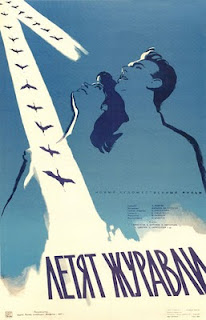
(The Cranes are Flying, 1957, Mikhail Kalatozov)

WARNING: The spoilers are also flying.

Watching The Cranes are Flying finally made me fully understand why I'm still working on this project. A lot of the time I get kind of worn out with this little experiment. I think to myself, "I don't want to watch all of this random stuff, I just want to watch Mean Girls and Fargo and talk about movies that I already know that I love." I have to force myself to bump foreign films and documentaries up to the top of my Netflix queue, and then I shudder a little bit when they show up in the mail. I know that I started this project myself, and nothing is forcing me to complete it, but I really feel like I've committed myself to it and now I have to stick it out, even through the things that I don't like or don't want to see. Then, miraculously, on my train ride to Seattle I watched The Cranes are Flying and I remembered why I wanted to start this in the first place.

I mentioned in my post for M that it's one of my favorite films, but I failed to mention that the first time I saw it was for a film history class. If it hadn't been for that class it might have taken me years to sit down and watch M, or I may never have seen it at all. The List did a similar thing for me with The Cranes are Flying. If it hadn't been on The List I probably would have never even heard of it, let alone seen it. Which would have been a great tragedy, because it's remarkable. In 97 minutes it manages to allow the audience to fully connect with the main character, Veronika, and almost feel her pain right along with her. On top of that, it's uniquely and beautifully filmed in a way that I would have never expected a 1950's Russian film to be (not that I know much about Russian film, but The Cranes are Flying certainly shattered all of my expectations).

The Cranes are Flying is about two people in love. Veronika (played by Tatyana Samojlova, who reminds me of a Russian Audrey Hepburn or Natalie Wood) is in love with Boris (played by Aleksey Batalov), but Boris goes off to fight in the war and Veronika is left alone. What's even more heartbreaking is that she doesn't get to say goodbye. When she goes to his house to see him off he is already gone, and she gets lost in the crowd when she goes to find him with the other soldiers. Her only token of him is a squirrel doll that he got her for her birthday, chosen because his nickname for her is Squirrel. Their love is sweet and pure, and watching her face as she realizes that she's not going to see him for one last time before he goes to the front is heartbreaking.

I think what I really liked about The Cranes are Flying is the fact that even though it's definitely about war, it's really just about people. I found myself actively feeling bad for Veronika, honestly wishing that Boris was still alive and was coming back to her. I don't often feel that for characters in movies. I mean, I care about the characters, but I fully wanted to believe that Boris wasn't dead and that the couple would get to live the life that they were planning together. And when she finally realized that he was really, truly not coming back I had to stop myself from crying on the train between Portland and Seattle. It was like how I sometimes feel when I watch Moulin Rouge (which, tragically, is not on The List). I find myself actively hoping that Satine won't die and she and Christian will continue to be happy and in love. Sometimes I even stop the DVD before she dies and pretend that it ends that way. But, alas, it is not. Nor is it that way in The Cranes are Flying. Which is tragic, but probably much better for the integrity of the film.

I am genuinely glad that I have seen The Cranes are Flying. It's a movie that I will recommend to people, and it's something that I would show to a film class if I was ever lucky enough to be teaching a film class. And I have nothing but The List and this project to thank for it. For the first time in a few months I am supremely happy that I am taking this on because it has exposed me to something that I can truly and honestly say that I love. It has renewed my faith in foreign films and The List, and I just could not be happier about it. So thank you, The Cranes are Flying. Now I won't dread it when a foreign film shows up in my mailbox.


October 26, 2010

#24: Well, Nobody's Perfect!

(Some Like It Hot, 1959, Billy Wilder)

Some Like It Hot is easily one of the most perfect comedies ever made. It's has mobsters, cross-dressers, musicians, and dirty old men. It stars Jack Lemmon, Tony Curtis, Joe E. Brown, and Marilyn Monroe. And it was directed by Billy Wilder. I mean, it has a lot going for it. So, even though I had vowed to watch more of the "weird movies" on The List, I decided to revisit Some Like It Hot in honor of Tony Curtis's recent passing. It felt like the right thing to do, and after a week of being sick I decided that I deserved something that was going to make me laugh.

Here's a basic rundown of the plot of Some Like It Hot: two musicians witness the St. Valentine's Day Massacre, and in order to escape being murdered by Spats Columbo they disguise themselves as women and join an all-girls band whose star is Sugar Kane (played by Marilyn Monroe). Tony Curtis's Joe becomes Josephine and Jack Lemmon's Jerry becomes Daphne. Of course, this being a comedy, much of the "dress up as women and escape the mobsters" plan goes awry. Joe ends up falling in love with Sugar, and he carries out that love by pretending to be the millionaire owner of Shell Oil. Jerry, on the other hand, ends up as the object of someone else's affection, which would be just fine if it weren't for the fact that the someone else is a man, and that man falls in love with Jerry's female alter-ego Daphne. Joe E. Brown's Osgood falls hard for Daphne, and Jerry is willing to play along with it in order to reap the benefits of being loved by a millionaire. Then, if that's not complicated enough, Spats and his gang all show up at their hotel and Joe and Jerry must escape, all with the added trouble of dealing with their respective paramours.

I usually try to avoid plot synopses in these posts unless I'm writing about a movie that I expect few people to have seen or if the plot is especially complicated. Some Like It Hot has neither of those problems. I expect most people to have seen it, and the plot is definitely not that complicated. In this instance I pretty much just used the plot synopsis to take up space. That may seem shameless, but the truth is this: I don't have a whole lot to say about Some Like It Hot other than that it's a great film and everyone should see it. I could ramble on about that for a few hundred words, but that's boring and unexciting, so I just gave kind of a rundown of the plot, even though that's kind of boring and unexciting also. And now I'm rambling on about the reason for the plot synopsis because I'm really reaching for things to write about here, people.

I do want to close with this, though. I bumped Some Like It Hot to the top of my Netflix queue the day that Tony Curtis died because I thought it would be an appropriate way for me to honor his passing. I'm not a wild Tony Curtis fan, but I know that he was a very popular actor, and I thought it was a good idea to somehow recognize the end of the life of someone who contributed quite a bit to the American film industry. However, while watching Some Like It Hot, I was struck by something. Tony Curtis was, up until a month ago, the last surviving star of Some Like It Hot. He may have even been the last surviving cast member, but I have absolutely no way of proving that, so I'm going to stick with "last surviving star." Which is incredible. This film was made in 1959, just barely over half a century ago, and none of the stars of the film (or the director, for that matter) are alive anymore.

While Some Like It Hot is definitely a funny movie, I had a seriously sobering moment when I came to that realization. It was an interesting glimpse of human mortality and the impermanence of life, and even though I was laughing like crazy at Tony Curtis ripping of one of Jack Lemmon's "chests," I was kind of happy for that moment of reflection. For me, in a way, the fact that none of the stars of the film are still alive somehow elevates it. It made it distant and unreachable, and for some reason it was that much better for it. Now more than ever it feel like I was watching not just a film, but a piece of history, and it makes me feel good to know that this particular piece of history will live on and make people laugh for many, many years to come.

October 19, 2010

#23: You Betcha!

(Fargo, 1996, Joel Coen)

Warning: There are spoilers ahead, doncha know? Yah, you betcha!

Going into this post I know that there is absolutely no way that I'll be able to write anything that will adequately describe how much I love this movie, or the Coen brothers in general. I adore them. That's all. I'll admit that I haven't seen all of their movies, and there's at least one that I won't see because I don't want to tarnish my opinion of them, but I am entirely convinced of their brilliance, which Fargo is an excellent example of. It's genius, and that's all there is to it.

The Coens are clever guys. Fargo begins with text that reads "THIS IS A TRUE STORY. The events depicted in this film took place in Minnesota in 1987. At the request of the survivors, the names have been changed. Out of respect for the dead, the rest has been told exactly as it occurred." Well, that's a lie. Kind of. In reality, the Coen brothers drew inspiration from a few different cases and sort of combined them and relocated them in order to get Fargo. Two of the cases that form the basis for the story (the kidnapping of Virginia Piper and the murder of Carol Thompson) actually took place in Minnesota. Essentially, those two incidents were combined to become Jerry Lundegard's plot to have his wife kidnapped and then have his father-in-law pay the ransom, which he exaggerated so that he could pocket most of the money to pay off his debts. The third crime that inspired the Coen brothers actually took place in Connecticut, was far more gruesome, and ended being one of the most memorable parts of the film. That event was the murder of Helle Crafts, whose husband killed her and attempted to dispose of her remains with the help of a woodchipper.

So... why the "based on a true story" introduction? The Coens have said that they added the disclaimer to encourage viewers to suspend disbelief, which actually makes some sense. As Joel Coen himself puts it, "if an audience believes that something's based on a real event, it gives you permission to do things they might otherwise not accept." And, in a way, Fargo is presenting the truth, it's just the truth through the Coen brothers' filter. It's a few truths mixed with some fiction and then all mashed together to make one really good movie about a pregnant police chief and some really inept criminals. Someone gets put through a wood chipper, but it's not Lundegard's wife. Lundegard does hire two guys to get rid of his wife, though he hires them to kidnap her rather than murder her (I guess she ends up dead anyway though, so that's kind of a moot point). But the point is that the truth is mixed in there. Sure, the disclaimer asserts that the entirety of the film is truthful, and that's a lie, but the film isn't entirely untruthful either, which is kind of what makes it fun. It's fun to pick the little tidbits of truth out of the fiction.

I feel like this post is really short considering how much I like this movie, so I'm going to spend a little bit of time on the cast, because it really is a remarkable cast. William H. Macy plays Jerry Lundegard so well that "perfectly" doesn't seem to be a strong enough word. He stutters, sweats, and all together fails to hide his guilt, all while his incredibly expressive face shows every note of panic and fear that crosses it. Steve Buscemi and Peter Stormare play Carl Showalter and Gaear Grimsrud, the two criminals hired to kidnap Lundegard's wife. Showalter just can't stop talking, with Buscemi making him simultaneously insufferable and somewhat sympathetic. Stormare plays silent, chain-smoking Grimsrud with calm and patience, until his patience with Showalter finally cracks and he murders him and shoves his body into a woodchipper. Finally there's Frances McDormand, whose portrayal of Marge Gunderson won her an Academy Award. Marge Gunderson is arguably the only character in the film who has any idea what she's doing, and while she doesn't succeed in stopping any of the crimes from being committed, she does succeed in catching the criminals. Her bubbly "Minnesota nice" accent makes her seem air-headed and silly, but she's tougher than she looks and she knows what she's doing. As the only one of the main characters who's unequivocally good, Marge Gunderson gets exactly what she deserves; to go home to her husband knowing that she's a good person who's done a good job. And Frances McDormand got exactly what she deserved; a nice, shiny Oscar.

So that's it. I love Fargo, and I love the Coen brothers. I'm excited that some of their films that I haven't seen are on The List because it will give me a chance to evaluate some of my thoughts about their entire collection of work. For now I just hold Fargo close to my heart as one of those films that is just good because it's good. It's well-written, well-acted, and well-directed, and there's not much more you can ask for.

October 15, 2010

#22: Brad, Your Sister's Turning Into a Fox!

(Fast Times at Ridgemont High, 1982, Amy Heckerling)

Fast Times at Ridgemont High has gained most of its fame and notoriety from one particular scene in which Phoebe Cates, clad only in a skimpy red bikini, emerges from a swimming pool and proceeds to unclasp the front of that red bikini and reveal her breasts. In 1982 that scene fueled the fantasies of thousands, perhaps millions, of high school boys, and Fast Times at Ridgemont High went down in history because of it. Well, that, and the fact that it was one the first film roles for future Oscar-winner Sean Penn, who plays perpetually stoned surfer dude Jeff Spicoli. But it's mostly famous for that bosom-baring scene, which I suppose is completely understandable.

The Guardian justifies Fast Times at Ridgemont High's placement on The List by saying that "everybody here became a star, down to minor player Forest Whitaker," which I guess is also completely understandable. Sean Penn and Forest Whitaker have both gone on to win the Oscar for Best Actor, Phoebe Cates went on to star in another popular 80's movie in which she didn't show her boobs, Judge Reinhold had various parts in various comedies and family films, and Jennifer Jason Leigh continued to be hot in a bunch of movies and TV shows. Also, Nicholas Cage has a very small role, and we all know the career he's had since 1982. So yes, Fast Times at Ridgemont High is certainly studded with future stars and Phoebe Cates's breasts, but I'm just not sure that's justification enough.

I choose to believe that the most remarkable thing about the film is its source material. At the age of 22 Cameron Crowe was writing for Rolling Stone and decided to go back to high school and document his experiences there. The book that he wrote ended up becoming Fast Times at Ridgemont High. However, the character of "Cameron Crowe, undercover writer" is noticeably absent from the film. That's because while he was writing the book he decided to leave himself out of it for fear that it would negatively impact his ability to accurately portray what high school was like for the people he was observing. Which is pretty cool, I guess. I just ended up not finding the film all that compelling or exciting. It was a portrait of high school experiences, sure. But the high school life that was shown in the film was radically different from mine, so I found it hard to connect or even care.

However, I think what irks me the most about Fast Times at Ridgemont High's appearance on The List is The List's lack of Almost Famous, a film that is based on Cameron Crowe's early experiences as a writer for Rolling Stone and is also written and directed by Crowe himself. While the film is fictionalized and not a literal retelling of his life, it is a version of his life told through his own filter. It also happens to perfectly encapsulate a life that I occasionally wish that I had; the sometimes unglamorous but never unexciting life of a music journalist. Like Fast Times at Ridgemont High, Almost Famous is an essentially true story translated to film. Unlike Fast Times, Almost Famous has a structured plot and characters that I actually found myself caring about and sympathizing with. As such, I feel it is more deserving of a place on The List. But, alas, I do not get a say in that.

The rundown is this: I don't think that a film which is primarily famous for the presence of boobs is a legitimate addition to a list of films to see before you die. Sure, if you're attracted to girls that kind of thing is great fun, but I'd wager that it's safe to say that approximately half of the movie-watching population isn't attracted to girls, so this movie doesn't need to be on the list. Almost Famous should be. And for those who are uncertain about my logic, let me say this: there are boobs in Almost Famous, too. There are just interesting characters and an engaging plot as well.